Answering the Gnostics


The National Geographic Society has lately released, with great fanfare, the gnostic 'Gospel of Judas.' Along with the high praise the gnostic gospels receive in Dan Brown's novel 'The Da Vinci Code,' still ensconced on the best-seller list, it looks like boom times for gnosticism. But this once popular alternative spirituality has been misunderstood. (Critics may object, the problem with this movement is that it cannot be understood!) But whatever the gnostic writers were getting at, it wasn't Dan Brown's ideal of Jesus as a moral philosopher: “'My dear,' Teabing declared, until that moment in history, Jesus was viewed by His followers as a mortal prophet...a great and powerful man, but a man nonetheless. A mortal.'” (The Da Vinci Code, Dan Brown, Chapter 55).

The gnostic writers did not understand Jesus to be "a mortal." In the Gospel of Judas, Judas, not Peter, first confesses Jesus as immortal: “Judas [said] to him, 'I know who you are and where you have come from. You are from the immortal realm of Barbelo. And I am not worthy to utter the name of the one who has sent you.'” (Gospel of Judas, National Geographic Society).

Who, or what, is 'Barbelo'? The gnostic organizational chart of the heavenlies is subject to great variation, not to mention gender confusion. Here is one theory: "Great is the first aeon, male virginal Barbelo, the first glory of the invisible Father, she who is called 'perfect.'" (The Three Steles of Seth, p. 399, The Nag Hammadi Library.) This is a pagan gnostic treatise without any Christian trappings. Irenaeus was aware of Barbelo: "Some of them, then, set forth a certain Aeon who never grows old, and exists in a virgin spirit: him they style Barbelos. They declare that somewhere or other there exists a certain father who cannot be named, and that he was desirous to reveal himself to this Barbelos...Barbelos, glorying in these, and contemplating their greatness, and in conception [thus formed], rejoicing in this greatness, generated light similar to it. They declare that this was the beginning both of light and of the generation of all things; and that the Father, beholding this light, anointed it with his own benignity, that it might be rendered perfect. Moreover, they maintain that this was Christ..." (Irenaeus, Against All Heresies, Book I, Chapter 29:1). It is difficult to get a fix on the gender of this party: "And Its Thought became operative and revealed herself. She stood before It out of the splendor of the light...She is the perfect power, the Barbelo, the perfect Aeon of glory." (The Secret Book of John, The Other Bible, edited by Willis Barnstone, p. 54).

The gnostics did not disbelieve the deity of Jesus Christ. In the Gospel of Judas, Jesus reports the officiants at the Jerusalem temple offer sacrifices in His name: “Jesus said to them, 'Why are you troubled? Truly I say to you, all the priests who stand before that altar invoke my name. Again I say to you, my name has been written on this […] of the generations of the stars through the human generations. [And they] have planted trees without fruit, in my name, in a shameful manner.'” (Gospel of Judas, National Geographic Society). So far so good; the Bible confirms the Messiah's name is the name invoked in the temple: "In his days Judah shall be saved, and Israel shall dwell safely; and this is his name whereby he shall be called: Jehovah our righteousness." (Jeremiah 23:6). But as is clear throughout, and normal in a gnostic text, this name is not the name of the only God; the other disciples ignorantly serve another.

The author of 'Judas' perceives different destinies for different folks. The apostolic Bible calls out to all: "And the Spirit and the bride say, Come. And let him that heareth say, Come. And let him that is athirst come. And whosoever will, let him take the water of life freely." (Revelation 22:17). The gnostic gospel is not good news for 'whosoever will,' but only for "these people": “Jesus said, 'The souls of every human generation will die. When these people, however, have completed the time of the kingdom and the spirit leaves them, their bodies will die but their souls will be alive, and they will be taken up.” Where you end up does not depend on what you have decided, but on where you're from: “When Jesus heard this, he laughed and said to them, 'Why are you thinking in your hearts about the strong and holy generation? Truly [I] say to you, no one born [of] this aeon [world] will see that [generation], and no host of angels of the stars will rule over that generation, and no person of mortal birth can associate with it...'” 'Gnosis' means 'knowledge,' and it is to teach the elect who they really are that Jesus came into the world: “[Jesus] answered and said, 'Judas, your star has led you astray.' He continued, 'No person of mortal birth is worthy to enter the house you have seen, for that place is reserved for the holy.'” (Gospel of Judas, National Geographic Society).

This is a common theme in gnostic literature. You either got it or you ain't and if you've got it, no one can take it away: "The psychic men have been instructed in psychic matters; they are strengthened by works and mere faith and do not have the perfect knowledge; they belong to the earthly church. Good conduct is necessary for them, for otherwise they cannot be saved; but we spirituals shall certainly be saved not by conduct but simply because we are by nature spiritual. Just as the earthly cannot participate in salvation, for it is not capable of receiving it, so in turn the spiritual cannot accept decay, no matter what actions it undertakes. [...] Those of the church receive grace as a loan, and therefore will be deprived of it, but we have it as our own possession after it has come down from above from the ineffeable and unnameable Pair." (The Valentinian System of Ptolemaeus, p. 617, The Other Bible, edited by Willis Barnstone.) This is not a religion of altar calls. In mainstream Christianity, the Lord commands His disciples to preach the good news to "every creature:" And He said to them, “Go into all the world and preach the gospel to every creature." (Mark 16:15). But the gnostic gospel is not good news for every creature, only for some:

"There was a householder who had every conceivable thing, be it son or slave or cattle or dog or pig. . .There are many animals in the world which are in human form. When he identifies them, to the swine he will throw acorns, to the cattle he will throw barley and chaff and grass, to the dogs he will throw bones. To the slaves he will give only the elementary lessons, to the children he will give the complete instruction." (Gospel of Philip, p. 157, The Nag Hammadi Library in English, edited by James M. Robinson).

Irenaeus was acquainted with this gospel, and reports its contents:

"Others again declare that Cain derived his being from the Power above, and acknowledge that Esau, Korah, the Sodomites, and all such persons, are related to themselves. On this account, they add, they have been assailed by the Creator, yet no one of them has suffered injury. For Sophia was in the habit of carrying off that which belonged to her from them to herself. They declare that Judas the traitor was thoroughly acquainted with these things, and that he alone, knowing the truth as no others did, accomplished the mystery of the betrayal; by him all things, both earthly and heavenly, were thus thrown into confusion. They produce a fictitious history of this kind, which they style the Gospel of Judas." (Irenaeus, Against All Heresies, Book I, Chapter 31:1).

In this system, the creator of the world is not the highest God, but a being from a lower realm, Saklas: “Then Saklas said to his angels, ‘Let us create a human being after the likeness and after the image.’ They fashioned Adam and his wife Eve, who is called, in the cloud, Zoe.” (Gospel of Judas, National Geographic Society). Jesus purportedly prophesies the downfall of this party: "When Saklas completes the span of time assigned for him..." (Gospel of Judas, National Geographic Society). But some, not all, of the inhabitants of this world owe nothing to this creator; their spirits are from above: “Jesus said, 'This is why God ordered Michael to give the spirits of people to them as a loan, so that they might offer service, but the Great One ordered Gabriel to grant spirits to the great generation with no ruler over it—that is, the spirit and the soul.'” (Gospel of Judas, National Geographic Society). Jesus comes as liberator to give these people, not the others, the freeing 'knowledge' of who they really are.

As should be apparent by now, there is a rift here that cannot be bridged. The Bible does not, in either testament, in any way confirm that the Creator of this world is any other than the true and living God:

Who is the Creator?

The gnostic writers do not hesitate to describe Jesus as 'God'...or rather 'a god.' The problem is, being a god is not such a distinction in this system, because there's such a profusion of gods, archons, aeons, stars, firmaments, and what not: "“Adamas was in the first luminous cloud that no angel has ever seen among all those called ‘God.’” (Gospel of Judas, National Geographic Society). The system is polytheistic.

Some of the contemporary authors calling attention to gnosticism do not themselves believe the system at all. Author Dan Brown does not want it known that Christianity is in error because Christians fail to perceive that Jesus came from the immortal realm of Barbelo, far above the archons, rather than from the Creator of this world as Christians hold. Rather he wants it believed that Jesus was a mere mortal man. But the gnostics did not so believe.

Some of those celebrating the release of this new 'gospel' like it because it upsets mainstream Christianity's applecart, a religion they dislike for its exclusivist claims: "The Rev. Jayne Oasin, a social justice officer for the Episcopal Church, USA., says that 'to consider there to be only one truth is to me a form of oppression.'" (The Christian Science Monitor, 'Christian mavericks find affirmation in ancient heresies,' By G. Jeffrey MacDonald.) But the Gospel of Judas itself makes exclusivist claims, mocking the twelve disciples for ignorantly serving the Creator, a doomed god: "For to the human generations it has been said, ‘Look, God has received your sacrifice from the hands of a priest’—that is, a minister of error. But it is the Lord, the Lord of the universe, who commands, 'On the last day they will be put to shame.'" (Gospel of Judas, National Geographic Society). The gnostics found in true belief, not a precondition for salvation, but salvation itself.


How Many Gods?

Gnostic literature assumes a multiplicity of gods. The gnostic writers were aware the God who spoke through Isaiah counted only One such being, Himself...and they chuckled at His folly:


"And when she [Sophia] saw (the consequences of) her desire, it changed into a form of a lion-faced serpent. And its eyes were like lightning fires which flash. She cast it away from her, outside that place, that no one of the immortal ones might see it, for she had created it in ignorance. And she surrounded it with a luminous cloud, and she placed a throne in the middle of the cloud that no one might see it except the holy Spirit who is called the mother of the living. And she called his name Yaltabaoth...Now the archon who is weak has three names. The first name is Yaltabaoth, the second is Saklas, and the third is Samael. And he is impious in his arrogance which is in him. For he said, 'I am God and there is no other God beside me,' for he is ignorant of his strength, the place from which he had come." (The Apocryphon of John, pp. 110-111, The Nag Hammadi Library in English, edited James M. Robinson).


"Opening his eyes he saw a vast quantity of matter without limit; and he became arrogant, saying, 'It is I who am God, and there is none other apart from me.' When he said this, he sinned against the entirety. And a voice came forth from above the realm of absolute power, saying, 'You are mistaken, Samael' -- which is, 'god of the blind.'" (The Hypostasis of the Archons, p. 167, The Nag Hammadi Library in English, edited James M. Robinson).


"For the Archon was a laughingstock because he said, 'I am God, and there is none greater than I. I alone am the Father, the Lord, and there is no other beside me. I am a jealous God, who brings the sins of the fathers upon the children for three and four generations.' As if he had become stronger than I and my brothers!" (The Second Treatise of the Great Seth, pp. 368-369, The Nag Hammadi Library in English, edited James M. Robinson).


To these polytheists, it seemed downright comical that any god could be so ill-informed as to imagine himself the only one. What about all the others crowding around?

But Bible-believers are not laughing. He who makes this claim is the living God:


How many gods are known to the Bible?:

How Many Gods?

How many Gods?

Only One God Henotheism
What did the pagans believe? Finis Jennings Dake
Witnesses Origen

"And when he saw the creation which surrounds him and the multitude of the angels around him which had come forth from him, he said to them, 'A am a jealous God and there is no other God beside me.' But by announcing this he indicated to the angels who attended him that there exists another God. For if there were no other one, of whom would he be jealous?" (The Apocryphon of John, p. 112, The Nag Hammadi Library in English, edited James M. Robinson).


Who are they?

Who are the "other gods"?

Strange Gods Gods of Wood and Stone
Is a 'fake rose' a rose? Worship Him!
Counterfeit Bills Dark Matter
None Like Thee So-called Gods
God of this World Moses
Elohim Stars
Prince of Tyre Psalm 82
Lower than the Angels Before the gods
Only One God

Only One God

Worship One One Jehovah One God


Acculturation

Polytheism was the default condition in the world into which the early Christian missionaries went forth. The cache of gnostic literature discovered in Egypt reveals both explicitly pagan theological treastises...and also treatises expounding the same concepts, but with a thin layer of Christianity spread on top. The gnostic theologians were attracted to the central figure of the Christian story, but fit Him into their existing theological paradigm. They did not allow Jesus to break the mold. But those who travelled about with Him and listened to Him teach recalled Him repeating the Shema:

"Jesus answered him, “The first of all the commandments is: ‘Hear, O Israel, the LORD our God, the LORD is one.’" (Mark 12:29).

Christian missionaries in India today encounter the same mind-set. Many hearers are willing to adore Jesus Christ. They add a statuette to their collection, right next to Krishna. But when they hear they're expected to jettison Krishna, they balk.

To be sure the pagans did not always return the compliment. They say that imitiation is the sincerest form of flattery. But even the pagans could not understand why the gnostics kept bad-mouthing the natural world, in which most pagans found order and beauty. Indeed they could not fail to notice the many contradictions of the gnostic project: "Another point: God has care for you; how then can He be indifferent to the entire Universe in which you exist?...If He is absent from the Universe, He is absent from yourselves, and you can have nothing to tell about Him or about the powers that come after Him." (Plotinus, Against the Gnostics.)

There is a difference of opinion here. Was Jesus a polytheist who described Himself as one of a proliferation of gods, or did He repeat the Shema as Mark reports? The gnostics understood there was a dispute on this point: "Some say that God is one, who made a proclamation in the ancient scriptures. Others say that he is many." (The Tripartite Tractate, p. 91, The Nag Hammadi Library in English, edited by James M. Robinson). The information provided by the gnostics does not complement the apostolic gospel; the reader must choose.

Though the gnostics sought to fit the Christian revelation into their existing world view, the Christians did not want to fit in. As the Book of Acts reports, the apostles and their circle founded churches. When the demand was made of these churches that they call Caesar "Lord" and offer a pinch of incense to him, they would not. Why not, if they were polytheists like the gnostics?


Ye are Gods

"This is the Good, the aim of those who have Gnosis: to become God." (Hermes Trismegistus, Poimandres, The Other Bible, edited by Willis Barnstone, p. 572).

Does Psalm 82 confirm the gnostic ambition?

Ye are Gods
"I said, Ye are gods."
Elohim Family Portrait
God's Hands Mighty Ones
Theoi Church Fathers
Magistrates Zeus and Hera

360

Three hundred and sixty is a nice, round number: "The seventy-two luminaries themselves made three hundred sixty luminaries appear in the incorruptible generation, in accordance with the will of the Spirit, that their number should be five for each. The twelve aeons of the twelve luminaries constitute their father, with six heavens for each aeon, so that there are seventy-two heavens for the seventy-two luminaries, and for each [of them five] firmaments, [for a total of] three hundred sixty [firmaments …]." (Gospel of Judas, National Geographic Society). That is how many idols there were the Kaabah before its cleansing by Mohammed: "The knowledge thus variously acquired and treasured up in an uncommonly retentive memory, was in direct hostility to the gross idolatry prevalent in Arabia, and practiced at the Kaaba. That sacred edifice had gradually become filled and surrounded by idols, to the number of three hundred and sixty, being one for every day of the Arab year." (Washington Irving, Mohammed and His Successors, Parts I, Chapter VI.) This partial god-census from the Gospel of Judas is already three hundred and fifty-nine gods in excess of the only number our Lord ever counted: "How can you believe when you accept glory from one another and do not seek the glory that comes from the one who alone is God?" (John 5:44 NRSV).

Who is Jehovah?

The God of the Old Testament is Father, Son and Holy Spirit. The God of the New Testament is one and the same.

There are many New Testament proofs that Jesus Christ is Jehovah God, and just as many that God the Father is Jehovah God, and that God the Holy Spirit is Jehovah God. The Gnostics ejected 'God the Father' from the Old Testament, portraying Him as a strange god newly entered onto the scene in the New Testament.  But it is just as easy to prove the God of the Old Testament is the Father as it is to prove He is the Son -- a manifest proof the God of the Old Testament is triune. While gnosticism nurtured a luxuriant abundance of theogonies, their unifying theme is that Jesus came to proclaim a heretofore unknown God: "About the [one] who appeared in flesh they believed without any doubt that he is the Son of the unknown God, who was not previously spoken of and who could not be seen." (The Tripartite Tractate, p. 101, The Nag Hammadi Library in English, edited James M. Robinson). But the Bible does not confirm the Father of Jesus was "unknown" prior to the advent:


The Father is Jehovah God.

One Father God the Father God of Abraham
Only True God Doubtless Our Father
The Vineyard My Father's House High Priest
Father of the Messiah Israel the Firstborn Touch me Not
Rock Potter and Clay His Offspring
One God and One Lord Father of Lights Father of Mercies

If Jesus came to liberate His people form the ignorant tyranny of the creator-god, as portrayed in the Gospel of Judas, then He came in large measure to liberate them from Himself, the creative Logos by whom God made the worlds:


Jesus Christ is the Creator!

The Doctrine of the Trinity

What is the doctrine?

Biblical Proof:

Only One GodThe Father is GodThe Son is GodThe Holy Spirit is God

The four propositions proven above: that

a.) There is only One God;
b.) The Father is God;
c.) The Son is God;
d.) The Holy Spirit is God.

-- are at the heart of the fifth-century Athanasian Creed: "So the Father is God, the Son is God, and the Holy Ghost is God.  And yet they are not three gods: but one God." Mormons concur with b.), c.) and d.); it's point a.) which needs remedial work!


Three-in-One

A common form of proof of God's triunity -- His 'Three-in-One'ness -- are the many instances where scripture ascribes one divine work indifferently to Father, Son and Holy Spirit. Creation, one case in point, is covered above in "The First Page". The principle: "With regard to the divine nature, on the other hand, it is otherwise. We do not learn that the Father does something on his own, in which the Son does not co-operate.  Or again, that the Son acts on his own without the Spirit. Rather does every operation which extends from God to creation and is designated according to our differing conceptions of it have its origin in the Father, proceed through the Son, and reach its completion by the Holy Spirit." (Gregory of Nyssa, On Not Three Gods). More cases in point:
Three in One


Who Raised Jesus from the Dead?
Who Authored Holy Writ?
Who Alone is Holy?
Who Sanctifies Believers?
Who Gives Eternal Life?
Who Supplies Pastors?

In the Image

Genesis 1:26-27 says, "Then God said, 'Let Us make man in Our image, according to Our likeness; let them have dominion over the fish of the sea, over the birds of the air, and over the cattle, over all the earth and over every creeping thing that creeps on the earth.'  So God created man in His own image; in the image of God He created him; male and female He created them." In whose image was man created? Saklas...or the true and living God?

In the Image

In the Image


God or Man?

The Incarnation

Methodology

Boosters of gnostic literature talk as if these gospels represent historical records of Jesus' publicly verifiable comments during His three-year earthly ministry: "'As the prophesied Messiah, Jesus toppled kings, inspired millions, and founded new philosophies. As a descendant of the lines of King Solomon and King David, Jesus possessed a rightful claim to the throne of the King of the Jews. Understandably, His life was recorded by thousands of followers across the land.' Teabing paused to sip his tea and then placed the cup back on the mantel. 'More than eighty gospels were considered for the New Testament, and only a relative few were chosen for inclusion -- Matthew, Mark, Luke, and John among them.'" (Chapter 55, The Da Vinci Code, Dan Brown). Literacy was widespread in the ancient world, and the events surrounding our Lord's passion were not done in a corner. Undoubtedly, many witnesses did record the Lord's sayings and doings; Luke shuffled through their reports, "Inasmuch as many have taken in hand to set in order a narrative of those things which have been fulfilled among us, just as those who from the beginning were eyewitnesses and ministers of the word delivered them to us..." (Luke 1:1-2). But is this how the gnostic literature describes its own methodology?

This author claims much more for this literature than it claims for itself, because the gnostic authors themselves often trace their material to post-resurrection, post-ascension appearances of the Lord Jesus: "After he rose from the dead, his twelve disciples and seven women continued to be his followers and went to Galilee onto the mountain...the Savior appeared, not in his previous form, but in the invisible spirit. And his likeness resembles a great angel of light..." (The Sophia of Jesus Christ, The Nag Hammadi Library, edited by James M. Robinson, p. 222.) They then report His 'secret' sayings on such occasions. In some cases the authors claim the authority of a 'name,' in other cases they are not even claiming this much. In no case should proposed secret, post-resurrection, post-ascension 'red-letter' sayings be described as a treasure trove of eye-witness, historical information, as the boosters describe it. There is a reason why these authors do not place their 'red-letter' sayings about Barbelo and company in a publically verifiable, historic setting. That is because the people who were eye-witnesses had not reported these sayings.

The recently rediscovered Gospel of Judas is an exception, however, siting the conversations it recounts prior to the crucifixion: "The secret account of the revelation that Jesus spoke in conversation with Judas Iscariot during a week three days before he celebrated Passover." (Gospel of Judas, National Geographic Society). The assumption, however, that this is bona fide historical information faces the difficulty that it is stated to be "secret," as well as the fact that Judas committed suicide shortly thereafter. If defenders claim a verifiable human, historic transmission line for this information, one cannot imagine what it might be. Whoever wrote this, and whenever he wrote it, he was not giving 'eye-witness' testimony.

A visionary source cannot be ruled out in advance, because our own New Testament contains 'red letter' sayings of the risen and ascended Lord, like, “Do not be afraid, but speak, and do not keep silent; for I am with you, and no one will attack you to hurt you; for I have many people in this city.” (Acts 18:9-10). But it is to be expected that the quality of such material will be uneven. Readers open to new 'red letter' sayings first heard by John on Patmos may be less receptive to those first heard by unknown persons residing in third century Syria, especially when the sayings delivered by these latter do not make sense. These authors were pursuing private visions of the risen Lord; some found what they sought, others delivered a spurious product. Under no circumstance ought believers to reject the Lord's documented, historic sayings in favor of such visionary material. Eye-witnesses report His repeating the Shema, visionaries report Him talking about Barbelo, Sophia and a whole crowd of newly come up deities. When visionaries report private interviews with the risen Lord in which He refutes His own prior public teaching, how hard can it be to decide which to discard, what to retain?

Docetism

The author of 'Judas' is aware that Jesus died upon the cross, because he makes Jesus say, "But you will exceed all of them. For you will sacrifice the man that clothes me." Some gnostics, however, denied this; some make it Simon of Cyrene who was crucified in Jesus' place, while Jesus stood by laughing. Others assert his 'likeness' only was crucified. Oddly enough this viewpoint found its way into the Koran, a rummage sale of aberrant theology.

"When he had said those things, I saw him seemingly being seized by them. And I said, 'What do I see, O Lord, that it is you yourself whom they take, and that you are grasping me? Or who is this one, glad and laughing on the tree? And is it another one whose feet and hands they are striking?'

"The Savior said to me, 'He whom you saw on the tree, glad and laughing, this is the living Jesus. But this one into whose hands and feet they drive the nails is his fleshly part, which is the substitute being put to shame, the one who came into being in his likeness. But look at him and me.'" (Apocalypse of Peter, p. 377, The Nag Hammadi Library, edited by James M. Robinson).

Not only is this view incompatible the Bible, but at least one Bible author, John, takes great pains to deny it:

Docetism

Diversity

Our time is a time of great diversity of religious opinion, with a wild profusion of sects proclaiming every old heresy, and some new ones. The early Christian centuries were likewise a time of great diversity: "For if he who comes preaches another Jesus whom we have not preached, or if you receive a different spirit which you have not received, or a different gospel which you have not accepted—you may well put up with it!" (2 Corinthians 11:4). It is alleged that this a good thing. But the apostles did not think so: "But even if we, or an angel from heaven, preach any other gospel to you than what we have preached to you, let him be accursed." (Galatians 1:8). While certain ways of arriving at uniformity, like the disastrous marriage of church and state, lead to ruin, the apostles' goal should be our goal.

“There are also those who heard from him that John, the disciple of the Lord, going to bathe at Ephesus, and perceiving Cerinthus within, rushed out of the bath-house without bathing, exclaiming, 'Let us fly, lest even the bath-house fall down, because Cerinthus, the enemy of the truth, is within.'” (Irenaeus, Against All Heresies, Book 3, Chapter 3:4).

The Gospel of Judas shows just what the problem is. The barbarously-named Barbelo is not the God of Israel. When it comes to gods, new is not good:

"If your brother, the son of your mother, your son or your daughter, the wife of your bosom, or your friend who is as your own soul, secretly entices you, saying, ‘Let us go and serve other gods,’ which you have not known, neither you nor your fathers, of the gods of the people which are all around you, near to you or far off from you, from one end of the earth to the other end of the earth, you shall not consent to him or listen to him, nor shall your eye pity him, nor shall you spare him or conceal him;..." (Deuteronomy 13:6-8).

Ingratitude

"Remember now your Creator in the days of your youth..." (Ecclesiastes 12:1)

We expect people to show gratitude to their benefactors. The law that came down at Sinai commands us to honor father and mother: they brought us into this world, they shared their food with us, they did not leave us out in the cold and the rain.

Yet the gnostics are not grateful to their Creator, though they admit it was He who created them, or at least some portion of their frame: the clay prison-house into which the divine spark of the alien god has somehow migrated. They admit it is the Creator who established the sun to shine upon them, and sends the cooling breeze on their face, yet they will not say 'Thank you.' They admit it is His beneficent order of nature which ripens the crops in the field that nourish them, but they are not grateful. They have, it would seem, abundant leisure in which to trace out their elaborate organizational charts of the heavenlies, yet they do not thank the God who put food on their table, though they admit it was He, not their unknown God. Would they rather He had left them to starve in the gutter?

If they pick up a seashell on their beach walks, they will not marvel at its intricate beauty, though their own god has produced nothing to rival the Creator's handiwork. Their own god, the alien god, made nothing, evidently not being in that line of work.

Like children of a broken home forced to prioritize their loyalties by the poisoned atmosphere of the divorce, they have chosen sides. But they have not chosen the custodial parent: the one who puts cereal in their bowl, who tucks them in at night. Another way of putting it is that they are plain ingrates.

Which Side are You On?

God's children love their Lord: "Jesus said to him, ‘You shall love the LORD your God with all your heart, with all your soul, and with all your mind.’" (Matthew 22:37). The Bible teaches that God is good: "You are of purer eyes than to behold evil, and cannot look on wickedness." (Habakkuk 1:13). God's creation is good: "Then God saw everything that He had made, and indeed it was very good." (Genesis 1:31).

In gnosticism all this is inverted. The God of Israel is evil. The 'heavies' of scripture, people like Cain and Korah, are heroes because they rebelled against the evil God of Israel. In this new gospel, Judas is quite consistently added to the gnostic honor roll. The snake in the Garden of Eden is good: he is mankind's 'instructor:'

"They hid under the trees in Paradise. Then, because the Rulers did not know where they were, they said, 'Adam, where are you?' [...] Then they said to that woman, 'What is this you have done?' She answered and said, 'The instructor is the one who incited me, and I ate.'...They merely cursed him since they were impotent. Afterward they came to the woman, and they cursed her and her sons. After the woman they cursed Adam and the earth and the fruit because of him. And everything which they created they cursed. There is no blessing from them. It is impossible that good be produced from evil." (On the Origin of the World, pp. 71-72, The Other Bible, edited by Willis Barnstone).

It was because of God's fear of man's knowledge that Adam and Eve were expelled from Paradise:

"Behold, Adam has become like one of us, so that he understands the distinction of light and darkness. Now lest perhaps he is deceived in the manner of the Tree of Knowledge, and he also comes to the Tree of Life and eats from it and becomes immortal and rules and condemns us and regards us and all our glory as folly -- afterward he will pass judgment on us and the world -- come, let us cast him out of Paradise..." (On the Origin of the World, p. 72, The Other Bible, edited by Willis Barnstone).

This is atheism gone postal. The gnostics hate the God of Israel and look forward to his (their) demise, which, indeed, they are plotting. The "fourth race," the elect, "will pass judgment on the gods of Chaos and their powers." (On the Origin of the World, p. 73, The Other Bible, edited by Willis Barnstone). Thunder signals the twilight of the gods:

"Before the consummation of the Aeon, the whole place will be shaken by a great thunder. Then the Rulers will lament, crying out on account of their death. [...] She will cast them down to the abyss. They will be wiped out by their own injustice. For they will become like the mountains which blaze out fire, and they will gnaw at one another..." (On the Origin of the World, p. 74, The Other Bible, edited by Willis Barnstone).

The gnostics follow the Redeemer...who will "trample" the blind God of Israel:

"And he rejoiced in his heart, and he boasted continually, saying to them, 'I do not need anything. I am God and no other one exists except me.'...when Pistis saw the impiety of the chief Ruler, she was angry. Without being seen, she said, 'You err, Samael,' i.e., 'the blind god.' 'An enlightened, immortal man exists before you. He will appear within your molded bodies. He will trample upon you as potter's clay is trampled. And you will go with those who are yours down to your mother, the abyss.'" (On the Origin of the World, p. 65, The Other Bible, edited by Willis Barnstone).

God's word asks, "Then Moses stood in the gate of the camp, and said, Who is on the LORD‘S side? let him come unto me." (Exodus 32:26). You cannot agree with the gnostics that the creator is blind, evil, and bound for destruction, and also agree with God's word: "But the LORD is the true God; He is the living God and the everlasting King. At His wrath the earth will tremble, and the nations will not be able to endure His indignation. Thus you shall say to them: 'The gods that have not made the heavens and the earth shall perish from the earth and from under these heavens.' He has made the earth by His power, He has established the world by His wisdom, and has stretched out the heavens at His discretion." (Jeremiah 10:10-12).

It is incredible that this new gospel is reported in the media as if it were helpful instruction. Christians serve the God of Israel. You cannot love God and hate Him; you cannot serve Him and conspire to bring Him down. This information is about as useful to God's people as Nazi propaganda was to General Eisenhower.

When and Where?

An earlier generation of Bible critics sorted through Paul's letters, tossing out some on grounds that letters condemning gnostic teachings could not have been written by Paul because that heresy had not yet appeared. Now, in their wild oscillations more reminiscent of the fashion world than the scholarly, they date gnostic writings prior to orthodox. What is the truth?

There is no reason to reject the Bible's testimony that this heresy, or some embryonic form of it, had already appeared while Paul was writing his letters in the 50's and 60's A.D. Where? Egypt?

The most jarring note the gnostic writers strike is their 'other' interpretation of the Old Testament. But one hears the same in the present day from Bishop Spong and the atheists. Instead of being adored as a God of loving-kindness, the Old Testament God is condemned on moral grounds, and mocked as inept on the strength of scriptures like, “Where are you?” (Genesis 3:9). This 'other' Bible interpretation was already prepared and came ready to hand. Bishop Spong needed to undertake no more creative work to adopt the atheists' Bible interpretation than first to adopt their attitude.

Atheism was unpopular in those days, but the gnostics needed to look no further for their ready-made source than to Egyptian anti-semitism. The Coptic-speaking inhabitants of Egypt, in spite of being the autochthonous inhabitants of the land and heirs to a great civilization, were no more than fourth-class citizens in their own native country. They were already behind the Greek-speakers who had been the governing elite under the former regime, and lately behind whatever Italian carpet-baggers passed through town. They were behind also Alexandria's Jews, who had been allotted special privileges under the early emperors, presumably under the old imperial adage of divide and conquer. This population's rage nourished, and was nourished by, the publishing industry. Authors like Apion supplied the goods.

Apion identified the God of Israel with a totemic animal: the ass: "Apion hath the impudence to pretend that 'the Jews placed an ass's head in their holy place;'..." (Josephus, Against Apion, Book II, Chapter 7).

Empire-building tossed all manner of different peoples into one cauldron, and it was standard practice for pagan theologians to try to identify foreign gods with those familiar to them. These identifications seem forced to modern readers, based as they often are on a single shared attribute, such as a hardware implement an otherwise differently-described god holds in his hand. To readers who identify the pagan gods as mere names, poetic fictions, made-up protagonists of made-up stories, their number might well be infinite. But to believers who reckoned them real beings of universal sway, not fictions, not local phenomena, there was no alternative to the strategy of identification.

This strategy went badly awry with the God of Israel, who is not numbered amongst the gods of the nations. An Egyptian, starting with the assumption that all gods have animal forms, might come to a different conclusion reading the story of Balaam's ass than a reader who understands God's transcendence. The error would be compounded realizing what deity has the ass as its emblem: a bad actor, Typhon: "...but the power of Typhon although dimmed and crushed, and still, as it were, in the last agony and convulsions, they nevertheless propitiate and soothe by means of certain sacrifices: but occasionally they humiliate and insult him at certain festivals, when they abuse red haired men and tumble an ass down a precipice...and altogether, they regard the ass as an unclean and daemon-like animal on account of his resemblance to that personage..." (Plutarch, Isis and Osiris, Chapter XXX). Since Typhon was a bad god, linking him with Jehovah yields the 'other' Old Testament of the gnostics.

As to why any nominal Christian would adopt this interpretation of the Old Testament, why has Bishop Spong adopted it? Some read the Old Testament and throw themselves down to worship; others despise the God revealed therein. Not everyone is headed in the same direction.

Another possibility is Samaria. Early Christian writers finger Simon Magus and Dositheus as the first gnostics:

“When, therefore, I had ascertained that the God who created the world, according to what the law teachers, is in many respects weak, whereas weakness is utterly incompatible with a perfect God, and I saw that he is not perfect, I necessarily concluded that there is another God who is perfect. For this God, as I have said, according to what the writing of the law teaches, is shown to be weak in many things. In the first place, because the man whom he formed was not able to remain such as be had intended him to be; and because he cannot be good who gave a law to the first man, that he should eat of all the trees of paradise, but that he should not touch the tree of knowledge; and if be should eat of it, be should die. For why should he forbid him to eat, and to know what is good and what evil, that, knowing, he might shun the evil and choose the good?. . .

“Thus then, since he who made man and the world is, according to what the law relates, imperfect, we are given to understand, without doubt, that there is another who is perfect. For it is of necessity that there be one most excellent of all, on whose account also every creature keeps its rank. Whence also I, knowing that it is every way necessary that there be some one more benignant and more powerful than that imperfect God who gave the law, understanding what is perfect from comparison of the imperfect, understood even from the Scripture that God who is not mentioned there. And in this way I was able, O Peter, to learn from the law what the law did not know. But even if the law had not given indications from which it might be gathered that the God who made the world is imperfect, it was still possible for me to infer from those evils which are done in this world, and are not corrected, either that its creator is powerless, if be cannot correct what is done amiss; or else, if he does not wish to remove the evils, that he is himself evil; but if he neither can nor will, that he is neither powerful nor good. And from this it cannot but be concluded that there is another God more excellent and more powerful than all.”
(Simon, 'quoted' in the Clementine Recognitions, Book 2, Chapter 53-54).

It might seem strange that this same literature ascribes the reductive teachings of the Sadduccees to the same teacher, Dositheus, from whom Simon learned his trade of travelling deity. But we are seeing the same phenomenon in the world today. If liberalism were to be described as a religion rather than the collapse of religion, it would have to be defined by a set of negations,-- Jesus was not born of a virgin, Jesus did not walk bodily out of an empty tomb,-- just like the Sadduccean faith must be circumscribed by a set of negations. These planks are rejected on grounds that science has discovered men do not commonly walk out of tombs, nor are commonly born to virgins. One might assume that folks who find monotheism too irrational would not rush headlong into the gnostics' profuse polytheism. One would be wrong; it's happening again today, witness the 'Da Vinci Code' with its divine marriage. These neo-gnostics have decided that Christianity won't do; goddesses enjoying divine assignations are so much more conformable to reason.

While the finished product is of undeniable originality, its component parts can be found here and there. One version of the Prometheus myth names this Titan as mankind's creator, a creative act for which he was punished by a higher god, Zeus. And while the pessimism of gnosticism startles those of a different mind-set, highly pessimistic world-views dominate the far east, in the form of Buddhism and Hinduism. The gnostic god is a god who has failed and retreated to such a safe distance as to be insulated from further failure: "Gnosticism does not fail; it cannot fail, because its God is at once deep within the self and also estranged, infinitely far off, beyond our cosmos." (Harold Bloom, Omens of Millenium, p. 30)

The Potter and the Clay

God foretold this strange heresy through the prophet Isaiah:

“Woe to him who strives with his Maker! Let the potsherd strive with the potsherds of the earth! Shall the clay say to him who forms it, ‘What are you making?’ Or shall your handiwork say, ‘He has no hands’? Woe to him who says to his father, ‘What are you begetting?’ Or to the woman, ‘What have you brought forth?’”
(Isaiah 45:9-10).

Paul quotes this verse, “But indeed, O man, who are you to reply against God? Will the thing formed say to him who formed it, ‘Why have you made me like this?’” (Romans 9:20). Paul was the gnostics' favorite New Testament author; the strange names borne by their orders of deity often come from Paul's vocabulary: 'fullness,' (pleroma), or 'ages,' (aeons). Paul, a monotheist, does not use these words to name orders of deity. But so naming the gnostics' congresses of gods did give them a bookmark when skeptics asked, 'where is that in the Bible'?

Was it Plato's Fault?

Christian authors like Aurelius Augustine have been at once orthodox Christians, and also Platonists. To be sure there are some musings of Plato with which no Christian would wish to be associated, such as his odes to child molestation in the Symposium. His totalitarian politics are at the opposite pole from democracy. Nevertheless, if the Bible record of creation is true, and the world is the product of the Logos, certain things Plato pointed out must be true: that the blueprint labelled 'tiger' must pre-date all actual tigers, and survive their extinction.

Certain themes struck by the gnostics call Plato to mind. In his creation myth, the Timaeus, Plato reports mankind's creation as the production of lesser gods, not of the Highest God. The Highest God address this command to his underlings:

"'Gods, children of gods, who are my works, and of whom I am the artificer and father. . .now listen to my instructions:--Three tribes of mortal beings remain to be created--without them the universe will be incomplete, for it will not contain every kind of animal which it ought to contain, if it is to be perfect. . .do ye, according to your natures, betake yourselves to the formation of animals, imitating the power which was shown by me in creating you. The part of them worthy of the name immortal, which is called divine and is the guiding principle of those who are willing to follow justice and you--of that divine part I will myself sow the seed, and having made a beginning, I will hand the work over to you.'" (Timaeus 41).

In fairness, it was already a feature of the poets' religion that the supreme god, Jupiter, was not mankind's creator: mankind had lived happily and prosperously under his father, Saturn. Gnostics were not the only pagans who had experience in transferring their loyalties to the winning side.

Legacy

In twentieth century America, Communists sought to infiltrate the government, labor unions, and other key organizations. They were taught not to advertise their party affiliation. McCarthyism arose in response to this underhanded approach. Unfortunately, the remedy was a graver threat to America liberty than the original malady.

Gnosticism faced the early church with a similar dilemma. The church-going crowd sat happily hymning Jehovah; but there in their midst was an initiate, a 'knower,' who laughed at Jehovah and worshipped Barbelo, or Bythus. When you asked him what he believed, he might not tell you; it was a 'secret.' Sunshine is the best disinfectant, and these initiates knew enough to keep in the shadows.

When it was the Communists who were subjected to investigation and interrogation, some people held them up as shining examples of freedom under attack. But there would have been no campaign to unmask the Communists had they stood up as brave men and declared what they believed. If they had not masked themselves, they could not have been unmasked. Why the secrecy? Can democracy survive if the voters do not know candidates' true affiliations? They were not playing by the rules when they concealed their true beliefs and affiliations.

The New Testament church operated by consensus: "Then it pleased the apostles and elders, with the whole church, to send chosen men of their own company to Antioch with Paul and Barnabas, namely, Judas who was also named Barsabas, and Silas, leading men among the brethren. They wrote this letter by them: The apostles, the elders, and the brethren, to the brethren who are of the Gentiles in Antioch, Syria, and Cilicia: Greetings. . .it seemed good to us, being assembled with one accord. . ." (Acts 15:22-25).

The church response to the gnostic threat was to build up the bishops' authority. But this is not how it was planned; all Christians are priests:

"But you are a chosen generation, a royal priesthood, a holy nation, His own special people, that you may proclaim the praises of Him who called you out of darkness into His marvelous light; who once were not a people but are now the people of God, who had not obtained mercy but now have obtained mercy." (1 Peter 2:9-10).

The church was not intended to be a society where some people lord it over others: "You call Me Teacher and Lord, and you say well, for so I am. If I then, your Lord and Teacher, have washed your feet, you also ought to wash one another’s feet." (John 13:13-14). The church became an authoritarian society in response to this heresy's challenge. Bishops like Ignatius and Cyprian infantalized the laity, teaching the people to follow the bishop like little ducklings, because they were not bright enough to see through the gnostic mask. This distortion of church life grew steadily worse until, in the middle ages, the church was dispatching armies to murder heretics. The people who were "a royal priesthood" became spectators at church, not even admitted to communion in both elements; a church governed by the consensus of those "assembled with one accord" devolved into autocracy. Whose fault was it?

To the modern defenders of gnosticism, the gnostics were, not the root cause of the church's loss of her New Testament egalitarianism, but innocent victims, heroes standing up for freedom against the totalitarianism closing in. But had the gnostics defended their ideas in the public market-place rather than hiding behind their Wizard of Oz act, gnosticism would not have presented such an insidious threat. People invested years of their lives in achieving the standing to learn the gnostic doctrines. The apologists' strategy therefore was to force disclosure, because to learn these doctrines is to laugh. It was the gnostics' foes who wanted open and free public debate. Ideally, the remedy for bad speech is more speech. The gnostics wanted no speech, but only silence and secrecy. The people who would not play by the rules of religious controversy were the gnostics, not the orthodox.

If the gnostics were the romantic heroes their defenders claim: "We can see, then, that such gnosticism was more than a protest movement against orthodox Christianity. . .many gnostics, like many artists, search for interior self-knowledge as the key to understanding universal truths -- 'who we are, where we came from, where we go.'" (Elaine Pagels, 'The Gnostic Gospels,' p. 134) -- why not publicize, and defend, their 'discoveries'? The gnostics should be blamed for the church's slide into authoritarianism, not celebrated as free spirits: "We can see, then, how conflicts arose in the formation of Christianity between those restless, inquiring people who marked out a solitary path of self-discovery and the institutional framework that gave to the great majority of people religious sanction and ethical direction for their daily lives." (Elaine Pagels, 'The Gnostic Gospels,' p. 149).

Author Pagels' readers are expected to believe that heresy-hunters like Tertullian and Hippolytus were motivated by a desire to magnify Rome's power. This is the same Tertullian who ridiculed the gnostics as polytheists: "Tertullian ridiculed the gnostics for creating elaborate cosmologies, with multi-storied heavens like apartment houses, 'with room piled on room, and assigned to each god by just as many stairways as there were heresies: The universe has been turned into rooms for rent!'" (Elaine Pagels, 'The Gnostic Gospels,' p. xxix). But Tertullian did not really care about monotheism, we are expected to believe; he cared about political power. This is the same Tertullian who, for most of his Christian walk, was in fellowship with the Montanists, condemned as heretics by Rome. If his motive was to build up Rome's power, why did he choose fellowship with the Montanists rather than with Rome, when he could not have both?

Anti-pope Hippolytus makes an even unlikelier booster for Pope Callistus' ambitions. If Hippolytus and his colleagues were in the heresy-hunting game as a facade for power politics, with their real agenda being to magnify the Pope of Rome, then why condemn this same Pope as the heretic he was? This author cannot make herself believe that anyone really cares about whether there is only one god or a whole crowd, and so therefore the fuss must all be about something else: something real, like politics. Presumably the people who were dying because they would only confess one God were thinking about something else at the time; something important, like who was going to be elected bishop.

The apologists employed an argument against gnosticism which emphasized the shortness of the chain linking the churches of the second and third century to the apostles. They brought this up as a check on the gnostics' out-of-control New Testament interpretation. For example, when Paul talks about heights and depths: "For I am persuaded, that neither death, nor life, nor angels, nor principalities, nor powers, nor things present, nor things to come, nor height, nor depth, nor any other creature. . ." (Romans 8:38-39),-- he is, according to gnostic exegesis, sketching out the contours of his pantheon. As a check on such interpretation, the apologists called Paul's churches to testify. Paul had established churches throughout Greece and Asia Minor; he taught the members, and appointed officers (Acts 14:23). Nor was it really such a long time ago; while the people Paul taught face to face had gone on, some of those whom they in their turn had mentored were still around; there were still, at that time, only a few links in the chain. Now if Paul had intended to teach polytheism in his letters, as the gnostics contended, then why were the churches he founded consistent in their intentional commitment to monotheism? Given multiple, independent transmission lines, how could the message have become so corrupted, in only a few generations? Why would Paul teach the people he lectured face to face just the opposite of what the gnostics claimed he taught in his letters?

The apologists' argument emphasized how very short the transmission line was, as indeed it was in these authors' day. When a message must be repeated multiple times, opportunities for loss or degradation multiply. How could these authors have anticipated that their argument would in years to come be inverted, and the church would begin to glory in, not how short a transmission line connected her to the apostles, but how gloriously long, and filled with such colorful characters. By the institution-builders' logic, if a short transmission line is good, a long one is even better. According to 'The Gnostic Gospels,' not only did these apologists anticipate that their argument would be turned upside-down, this was just what they wanted. The gnostics were hapless bystanders to an argument that was really not about them. When, in centuries or indeed millenia to come churchmen would boast of how long the chain was stretching back to the apostles, this was just the same as the early church apologists stressing how very short it was. But how could sensible authors like Tertullian and Hippolytus anticipate a development of their argument premised on the notion that 'long' is no different from 'short'?

According to the author of 'The Gnostic Gospels,' Christians believe in Jesus' bodily resurrection because this belief fosters papal power:

". . .why did orthodox Christians in the second century insist on a literal view of resurrection and reject all others as heretical? I suggest that we cannot answer this question adequately as long as we consider the doctrine only in terms of its religious content. But when we examine its practical effect on the Christian movement, we can see, paradoxically, that the doctrine of bodily resurrection also serves an essential political function: it legitimizes the authority of certain men who claim to exercise exclusive leadership over the churches as the successors of the apostle Peter. From the second century, the doctrine has served to validate the apostolic succession of bishops, the basis of papal authority to this day." (Elaine Pagels, 'The Gnostic Gospels,' pp. 6-7).

Likewise with other doctrines. This author sees no more point in counting gods than in counting telephone poles, or license plates. Therefore, the apologists liked monotheism, not because they saw any more point than this author in counting gods, but because, in some mysterious way, it boosts the power of the bishop. Who knew? Did polytheism ever diminish the power of the Mormon hierarchy? Never mind. Imagine academia's surprise and perplexity should they discover there are people who believe in monotheism and resurrection who are not papists.

Gnosticism's gloomy legacy does not stop its wide-eyed admirers from trying, and trying, and trying, to get this turkey to get up and fly:

Bowdlerization

Where did author Brown come by his conviction that the gnostics were sensitive, New Age guys who celebrated Jesus' humanity? Certainly not from the barbarous yawp of their writings preserved in the Nag Hammadi library. Rather, this is the 'spin' placed on gnosticism by modern academia.

If your knowledge of gnosticism comes, not from contact with the original texts, but from modern academia, then you likely believe the gnostics were rational inquirers, free spirits on a quest for self-discovery. . . sort of like psychoanalysis: "For gnostics, exploring the psyche became explicitly what it is for many people today implicitly -- a religious quest. Some who seek their own interior direction, like the radical gnostics, reject religious institutions as a hindrance to their progress." (Elaine Pagels, 'The Gnostic Gospels,' p. 123).

This odd couple formed according to the dictum, 'the enemy of my enemy is my friend.' Gnostics and modern academics are drawn together by their shared disdain for orthodoxy:

"Gnostic Christians undoubtedly expressed ideas that the orthodox abhorred. . .Yet orthodox Christianity, as the apostolic creed defines it, contains some ideas that many of us today might find even stranger. The creed requires, for example, that Christians confess that God is perfectly good, and still, he created a world that includes pain, injustice, and death; that Jesus of Nazareth was born of a virgin mother; and that, after being executed by order of the Roman procurator, Pontius Pilate, he arose from his grave 'on the third day.' Why did the consensus of Christian churches not only accept these astonishing views but establish them as the only true form of Christian doctrine?" (Elaine Pagels, 'The Gnostic Gospels,' p. xxxv.-xxxvi.)

Facing this shared enemy, the academics mount a determined effort to find something positive to say about gnostic perspectives that the orthodox find unedifying, such as the notion that the Living God's assertion of monotheism was corrected by his mother:

"Others declared that his Mother refused to tolerate such presumption: '[The creator], becoming arrogant in spirit, boasted himself over all those things that were below him, and exclaimed, 'I am father, and God, and above me there is no one.' But his mother, hearing him speak thus, cried out against him, 'Do not lie, Ialdabaoth. . .'" (Elaine Pagels, 'The Gnostic Gospels,' p. 58).

A positive spin is placed on this frequently-occurring set-piece of inter-god dialogue, namely, that populating the heavenlies with goddesses is a progressive step on the road to gender equality. In pursuit of this goal, modern academics are willing to tolerate the occasional misogynist rant, like "'Woe to you who love intimacy with womankind, and polluted intercourse with it!'" (Thomas the Contender, quoted p. 66, Elaine Pagels, 'The Gnostic Gospels.'). In the eyes of their cheering section, gnostic contempt for human females is outweighed by their reverence for the goddess:

"Do not wash yourselves with death, nor rely on those who are inferior as if they were superior. Flee from the madness and the fetter of femaleness and choose the salvation of maleness." (The Sermon of Zostrianos, The Gnostic Bible, edited by Willis Barnstone and Marvin Meyer, p. 216).

But is there really any demonstrable association between populating the heavens with goddesses and improving the status of women down on earth? It was the goddess-worshipping Arabians who buried little girls alive, not Mohammed and his anti-goddess band.

The academics and the gnostics share a distaste for the Lord's bodily resurrection, though for different reasons. The academics hope it can be spiritualized away: "One could suggest that certain people, in moments of great emotional stress, suddenly felt that they experienced Jesus' presence." (Elaine Pagels, 'The Gnostic Gospels,' p. 6). The gnostics objected to the resurrection on the same grounds as they objected to the incarnation: because blood defiles, and death defiles, God cannot have stained Himself by taking on flesh, but can only have appeared to do so. The gnostics' revulsion at the flesh does not appeal to contemporary academia and is investigated no further.

Our thinking man's gnosticism is a work product of great creativity. To those who have been taught this contemporary gnosticism, what a cold bath of water contact with the raving gnostic texts must prove. How to tidy up all this mad yowling for modern consumption? By cutting and pasting. Judicious selection is the key to producing a gnosticism fitted to modern taste. After all what was found at Nag Hammadi was a library, not a creed; surely somewhere in there, in the selections from Plato's Republic if nowhere else, sweet reason may be found. In this vast store of material, something appealing and rational must lie hid; take a little from here, a little from there, sew it together, and author Brown's gnosticism stretches and rises to life.

The rational man who saves this enterprise is Silvanus, the Teacher. Silvanus, a Christian Philonist and professor of Logos Christology, sings paeans to the Logos, Divine Reason. Author Pagels seeks a gnostic who, "Like Freud," professes "to follow the 'light of reason,'" and Silvanus steps up to the plate: "Bring in your guide and your teacher. The mind is the guide, but reason is the teacher. . ." (Silvanus, quoted p. 127, Elaine Pagels, 'The Gnostic Gospels.')

Silvanus is indeed a rational man, and his arrival was just in time. Of course, he is no gnostic. He believes that the Creator God is good, not a fallen demi-urge: "Only the hand of the Lord has created all these things. For this hand of the Father is Christ, and it forms all." (The Teachings of Silvanus, The Nag Hammadi Library, James M. Robinson, p. 394). Quoting Hebrews 1:3, he teaches that the worlds were formed by the Word of God:

"O Lord Almighty, how much glory shall I give Thee? No one has been able to glorify God adequately. It is Thou who hast given glory to Thy Word in order to save everyone, O Merciful God. (It is) he who has come from Thy mouth and has risen from Thy heart, the First-born, the Wisdom, the Prototype, the First Light. For he is light from the power of God, and he is an emanation of the pure glory of the Almighty. He is the spotless mirror of the working of God, and he is the image of his goodness. For he is also the Light of the Eternal Light. He is the eye which looks at the invisible Father, always serving and forming by the Father's will." (The Teachings of Silvanus, The Nag Hammadi Library, James M. Robinson, p. 393).

He chides those who accuse the Creator of ignorance, as do the gnostics: "Let no one ever say that God is ignorant. For it is not right to place the Creator of every creature in ignorance." (The Teachings of Silvanus, The Nag Hammadi Library, James M. Robinson, editor, p. 394). He teaches the incarnation as a reality, not semblance: "Know who Christ is, and acquire him as a friend, for this is the friend who is faithful. He is also God and Teacher. This one, being God, became man for your sake." (The Teachings of Silvanus, The Nag Hammadi Library, James M. Robinson, editor, p. 392). He teaches that Christ truly bore affliction, and died: "Accept Christ, the narrow way. For he is oppressed and bears affliction for your sin. . .Although he was God, he [was found] among men as a man. He descended to the Underworld. He released the children of death. . .And when all the powers had seen him, they fled so that he might bring you, wretched one, up from the Abyss, and might die for you as a ransom for your sin." (The Teachings of Silvanus, The Nag Hammadi Library, James M. Robinson, editor, p. 389). He dislikes the gnostics' polytheism: "For he who says, 'I have many gods,' is godless.'" (The Teachings of Silvanus, The Nag Hammadi Library, James M. Robinson, editor, p. 386).

He is not altogether orthodox; Silvanus is an Origenist before Origen, because he suggests the pre-existence of the human soul: "When you entered into a bodily birth, you were begotten." (The Teachings of Silvanus, The Nag Hammadi Library, James M. Robinson, editor, p. 385). Moreover he's a misanthrope. But he's no gnostic. This harmless author was kidnapped off the street and impressed into the gnostic camp, because he is a rational man and rationality was what they lacked.

Jewish Gnosis

The popular school of Jewish mysticism known as the 'Kabbalah' first appeared in the world during the European dark ages. To the extent that this movement can credibly trace its origins back into antiquity, the trail leads to gnosticism. But gnosis is pagan syncretism. Does this mean the Kabbalists are circumcised pagans?

Thus begins the quest for an authentically Jewish gnosis. What is sought is found in the Book of Baruch, by Justin. Justin begins by retelling Hesiod's tale of Sky mating with Earth, whose offspring made men (Hesiod, Theogony). 'Earth' (Gaia) he translates; 'Sky' (Ouranos) is 'Elohim.' Pagan students of Judaism thought Jews worshipped the sky: "Some men who chance to be born of a father who's orthodox in keeping the Sabbath worship nothing but clouds and a kind of unseen God in the heavens." (Juvenal, Satires, XIV, 96).

Justin counts "three ungenerated principles," which is two more than monotheists count. One of the three is 'Elohim,' whose nature is to rise. Rising, he discovers a higher god:

"When Elohim reached the upper border of heaven, he saw a light stronger than the sun he created, and he said, 'Open the gates for me to enter and to acknowledge the lord. I had thought I was the lord!'" (Book of Baruch, The Gnostic Bible, edited by Willis Barnstone and Marvin Meyer, p. 128).

In the Book of Baruch, this most high god is revealed to be. . .Priapus!: "The Good is Priapos, who created before anything was. He is called Priapos because he made everything. So in temples everywhere he is honored by all creation." (Book of Baruch, The Gnostic Bible, edited by Willis Barnstone and Marvin Meyer, p. 132).

This actually does explain a lot about the Kabbalah, but because Thriceholy is a family-friendly site, I will say no more. The author also offers helpful information about Heracles, Leda and the Swan, and other pagan nonentities.

There has always been an 'other' Israel. God,-- not Priapus, nor Ouranos, but the living God,-- showed it to Ezekiel:

“And He said to me, 'Go in, and see the wicked abominations which they are doing there.' So I went in and saw, and there—every sort of creeping thing, abominable beasts, and all the idols of the house of Israel, portrayed all around on the walls. And there stood before them seventy men of the elders of the house of Israel, and in their midst stood Jaazaniah the son of Shaphan. Each man had a censer in his hand, and a thick cloud of incense went up. Then He said to me, 'Son of man, have you seen what the elders of the house of Israel do in the dark, every man in the room of his idols? For they say, “The LORD does not see us, the LORD has forsaken the land.”'” (Ezekiel 8:9-12).

At times, as under King Manasseh, the 'other' Israel has threatened to swamp the faithful remnant who still served the living God. We do not have before us the literature King Manasseh read, which encouraged him to meet the pagans half-way. . .except we do; the Book of Baruch cannot be far different. It is pagan syncretism.

Ogdoad

The canonical scriptures never provide a description of what the heaven/earth system looks like to an observer standing outside the system. Readers who insist that providing such a description is a central concern of religion are obliged to tease one from catch-phrases and figures of speech found here and there in scripture, like the 'ends of the earth;' never mind that people still use these same catch-phrases. Bible language is phenomenological, expressing what an observer on earth sees, never seeking to explain why it looks that way.

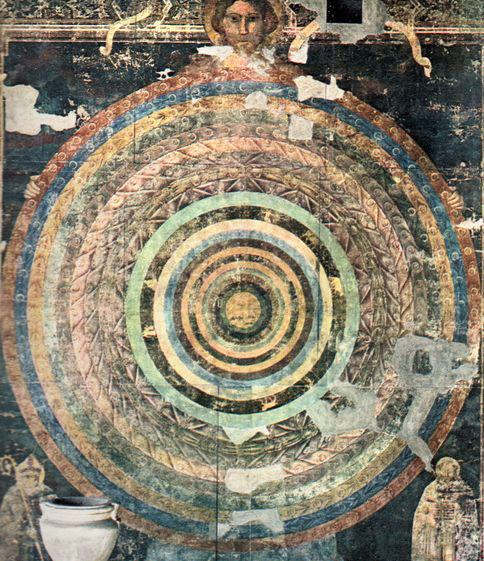
With gnosticism it is different. Readers become aware that the gnostic earth is nestled within eight concentric spheres. The first seven carry the wandering heavenly bodies known to antiquity: the moon, the sun, the planet Mercury, Venus, Mars, Jupiter and Saturn. These are the 'seven heavens' of rabbinic lore. The eighth sphere carries the fixed stars, which in this system rotate around a stationary earth. In keeping with the gnostic theme of acculturation, the gnostics were greatly impressed with Ptolemaic astronomy, in that day the best available scientific explanation of the apparent movements of the heavens: